


India’s Infrastructure Revolution Under Construction
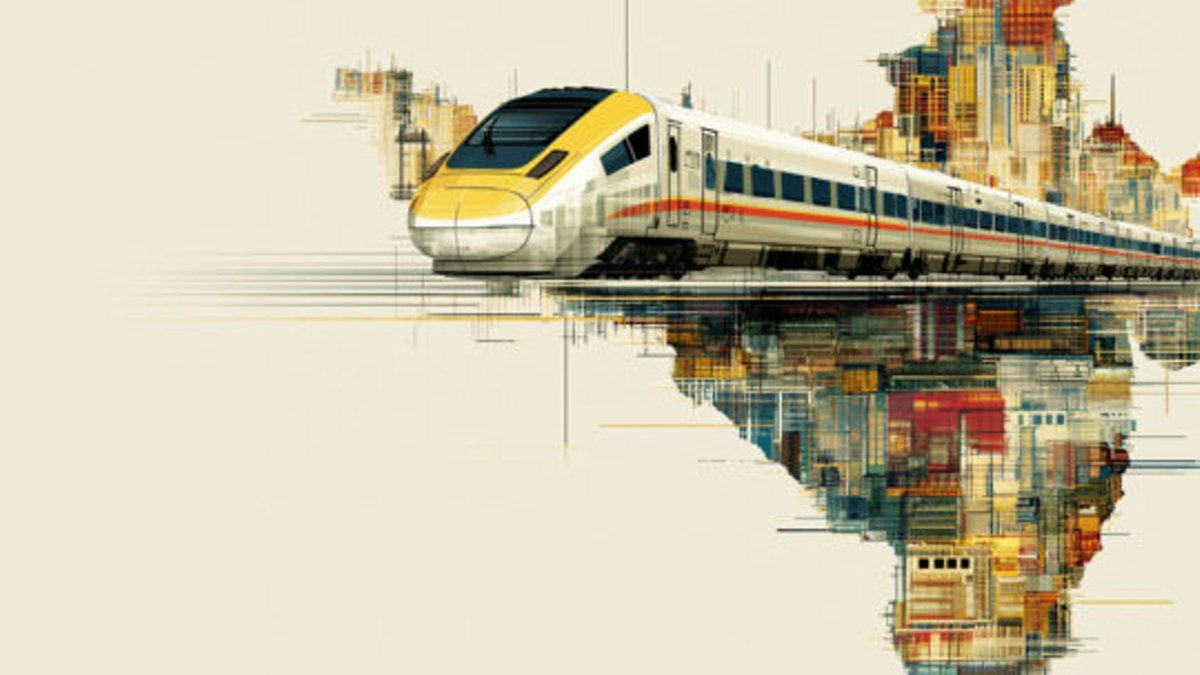
India is building one of the longest electrified rail systems in the world, a feat that has largely escaped global attention. When a container is hoisted ashore at Jawaharlal Nehru Port, it is placed aboard a high-capacity freight train running from Mumbai to industrial cities like Dadri and Khurja in Uttar Pradesh. The container is lifted off the next day, a process that is faster than in many other countries, including the United States.
The entire high-speed route is now electrified, with the final sections hooked up in January 2026. Before electrification, the trip would have taken three to four days. The completion of this final link created the country’s longest rail freight link, known as the Western Dedicated Freight Corridor. It also gave India one of the longest electrified rail systems on the planet.
India has electrified 100 percent of its network, a figure that puts it on par with Switzerland. By comparison, the UK can claim only 37 percent rail electrification and the United States just one percent. The rapidity of electrification has been astonishing; during the last six years, Indian Railways was adding over 15 kilometres of track every single day. The result is a network of 70,000 kilometres of electrified broad-gauge rail, part of a broader plan to modernize transport, energy, and shipping.
This transformation is not just about moving boxes. It is a physical manifestation of the economic policies known as “Modinomics,” which began in 2014. Since Prime Minister Narendra Modi won power after decades of socialist governments, the policy has faced skepticism from critics who argue the reforms were not working. Supporters, however, contend that change was long overdue in a country that is the seventh largest in the world by geography and the most populous, with 1.47 billion people.
According to Australia’s Treasury, the economy grew at an annual rate of 6.5 to seven percent during Modi’s first 10 years in power, maintaining its position among the world’s fastest-growing major economies despite a contraction in 2020. Most analysts, including the International Monetary Fund, predict this growth rate will persist through 2035. Significant hurdles persist, however, including entrenched bureaucracy and deep-seated political divisions. When Modi introduced radical changes to employment laws in 2014 to weaken obstructive union power and boost job creation, nearly 150 million workers in banking, manufacturing, and construction went on strike for 24 hours, costing the economy $3.5 billion.
Related: Mayor for the Modern Era Unveiled Today
Despite these disruptions, the data suggests a shift. India has reconfigured its manufacturing away from heavy industry toward high-margin sectors such as electronics, defense, and electric vehicles. The production of mobile phones has quadrupled in value between 2016 and 2024, and India has become one of the world’s biggest manufacturers of solar panels. Critics point out that small enterprises, which employ less than five people and account for nearly three-quarters of manufacturers, remain a drag on productivity due to complex compliance requirements and rigid labor regulations. While the “Make in India” push has not resulted in manufacturing outpacing other sectors in employment generation, it has undeniably shifted the industrial setting.
India’s push for electric vehicles (EVs) is perhaps the most ambitious part of this infrastructure revolution. The government set an audacious target for an all-electric transport sector by 2030, a deadline that outstrips even China’s ambitions. At the time of the announcement, just one percent of the country’s vehicles were electric. The program, known as FAME (Faster Adoption and Manufacturing of Electric Vehicles in India), was designed to start with rickshaws and commercial vehicles before moving to cars.
To accelerate adoption, the government encouraged battery-swapping technology. Manufacturers were awarded tax breaks to build cars without batteries, which could be swapped in stations in about two and a half minutes. Companies like Honda, Piaggio, and Shell saw the potential. Kasturi Gomatham, the global head of battery swapping at Shell, explained that this technology decouples the grid from charging needs and the battery from the vehicle itself, allowing users to avoid the high upfront cost of batteries.
The strategy has produced results. Battery-swapping is a roaring success, with one company, SUN Mobility, managing over 1.4 million swaps a month at nearly 650 stations across 20 cities. The market has grown rapidly, with EV sales jumping from just over 95,000 in 2017 to 1.6 million in 2024. This growth is driven largely by two- and three-wheelers, which are less important for emissions but more practical for the daily commute in India’s teeming cities.
As India pivots from fossil fuels to clean energy, these vehicles are helping drive the switch. The shift is critical because half of India’s oil imports are burned by vehicles. The Colorado-based Rocky Mountain Institute calculates that as early as 2030, 80 percent of two- and three-wheelers sold in India could be electric. This transition is part of a larger environmental strategy that includes planting forests to create a carbon sink of 2.5 to 3.0 billion tonnes of CO2 equivalent. Between 2005 and 2023, India slashed its emissions intensity by 39 percent, a figure that is ahead of target.
Related: How to Design a Diamond Ring with an Unexpected Shape
India’s infrastructure ambitions extend beyond rail and roads. The country is developing the Khavda renewable energy park in the salt deserts bordering Pakistan, a project five times the size of Paris that will produce 30 gigawatts of green energy from solar and hybrid solar-wind systems. Run by Adani Green Energy, the park is due for completion in 2029 and will power over 16 million homes. Currently, about half of India’s installed power capacity comes from non-fossil sources like solar and wind, a figure the government aims to raise to 500 gigawatts by 2030.
Maritime infrastructure is also under construction. India is building deep-draught mega-ports like Vadhaven, 150 kilometres from Mumbai, which is due for completion in 2034 and will rank among the top 10 ports in the world. Simultaneously, the government is simplifying paperwork to improve cross-port cooperation. In early 2026, the government approved a $1.66 billion kick-start for an all-Indian shipping company to exploit the country’s 14,500 kilometres of inland waterways.
Corruption remains a challenge. Transparency International ranked India at 84th on its Corruption Perception Index in the early 2000s. By 2026, the ranking had risen to 91st, roughly halfway down the list. The Central Bureau of Investigation has reduced its backlog of pending cases from over 9,000 to just over 7,000. Petty corruption is down, and senior tax and customs officials have been removed for fraud. While the situation is far from perfect, the government is actively working to clean up the funding pipeline for these massive projects.
The country’s most successful innovation may not be infrastructure at all, but sport. The India Premier League is a high-value sporting spectacle based on a franchise model. It is a symbol of commercial creativity and is home-grown, much like the electrified rail system that now moves goods across the subcontinent.

Mayor for the Modern Era Unveiled Today


